Eligia
A service that guides you without deciding for you: every aid scheme with its source, every organisation near you.
- Year
- 2026
- Stack
- Next.js · TypeScript · Supabase · Base Adresse Nationale · API Découpage administratif · Vercel
- Product design
- Web development
- API
- Public data
- Accessibility
- Copywriting

- of entries with an official source, a condition of publication
- 100%
- people per entry: one editor, a separate validator
- 2
- for individuals, browsing with no account
- €0
- paid ranking: no body pays for its visibility
- 0
What needed solving.
The background
Eligia is an access-to-rights service designed by KAYZEN, online in beta at eligia.kayzen-lyon.com. It helps everyone spot the public aid schemes that might match their situation, understand their conditions and find the competent body. The pilot covers the Rhône département and the Lyon Metropolis; national aid schemes are shown for the whole of France.
The constraint
Aid schemes exist, but they are scattered across many bodies, described in administrative jargon and subject to conditions that are hard to read. Simulators sometimes give the impression of an acquired right, when only the body concerned can grant it. What was needed was a service that informs and guides without ever deciding, that cites its sources, and that does not ask for personal data for a simple search.
The response
Three jargon-free steps: search, understand, contact the body. Eligia says that a person is “potentially concerned” and what remains to be checked, never that they are entitled to an aid scheme. Each entry carries its official source and the date it was checked; without a source, it is not published.
Every design choice, and the reason for it.
Search before everything else
The search field is placed in the very first view, with examples (student housing, transport, childcare) and a reassuring sentence: no personal information is requested to search.
Stating the real state of the service
A banner announces a service under construction and a pilot limited to the Rhône département and the Lyon Metropolis. The page states that no aid scheme is listed yet and that the catalogue is being built up as checks are made, rather than displaying usage figures that do not exist.
Commitments stated simply
The key figures are commitments, not volumes: 100% of entries sourced, two people per entry, €0 for individuals, no paid ranking. They answer the questions that a sometimes wary audience asks before placing its trust.
What's under the bonnet.
- Next.js
- TypeScript
- Supabase
- Base Adresse Nationale
- API Découpage administratif
- Vercel
A separate web application and API
The interface, built with Next.js, and the API are two distinct projects, deployed separately on Vercel. This separation makes it possible to evolve the catalogue and its validation rules without touching the public interface.
Public data from the French administration
The directory of bodies is based on the Annuaire de l'administration (the official directory of French public services); municipalities come from the API Découpage administratif (administrative boundaries) and addresses from the Base Adresse Nationale (the national address database). This data is reused under the Licence Ouverte (Etalab open licence), and its sources are cited in the footer.
Two people to publish an entry
An aid entry is written by one editor and validated by another person. Publication requires an official source. The quality of the information comes before the number of entries.
Nothing unnecessary about the person
The search only asks for a municipality or a postcode, never the address. Searches are not recorded in the logs, no data is sold and the site displays no advertising. An account will only be used, later on, to save one's procedures if one wishes.
How the site makes itself findable.
The vocabulary of users, not of the administration
The pages answer questions the way people ask them: “Can I find out whether I am entitled to an aid scheme?”, “Where does the information come from?”, “Do I need to create an account?”. The frequently asked questions on the home page use these wordings.
Usable by everyone.
Since June 2025, the European Accessibility Act has required digital accessibility from a large share of online services. We build it in at the design stage rather than retrofitting it.
An accessibility status displayed honestly
The footer states “Accessibility: non-compliant (not audited)” and links to the Accessibility page. For a service intended for everyone, saying that the audit is still to be done is better than suggesting a compliance that has not been established.
What was delivered.
- Home — search, how it works, commitments, frequently asked questions
- Search for an aid scheme — entries by topic and by area
- Find a body — CCAS, Caf, France services, local youth support centres
- Review my situation — optional questionnaire, no account
- Accessibility, legal notice, terms of use, personal data, cookies
How the project unfolded.
Scoping
Editorial rules: mandatory official source, double validation, the wording “potentially concerned”.
Directory
Bodies in the Rhône département and the Lyon Metropolis, based on public data.
Beta
Launched in November 2026; catalogue of aid schemes being built up.
What we are often asked.
More of our work
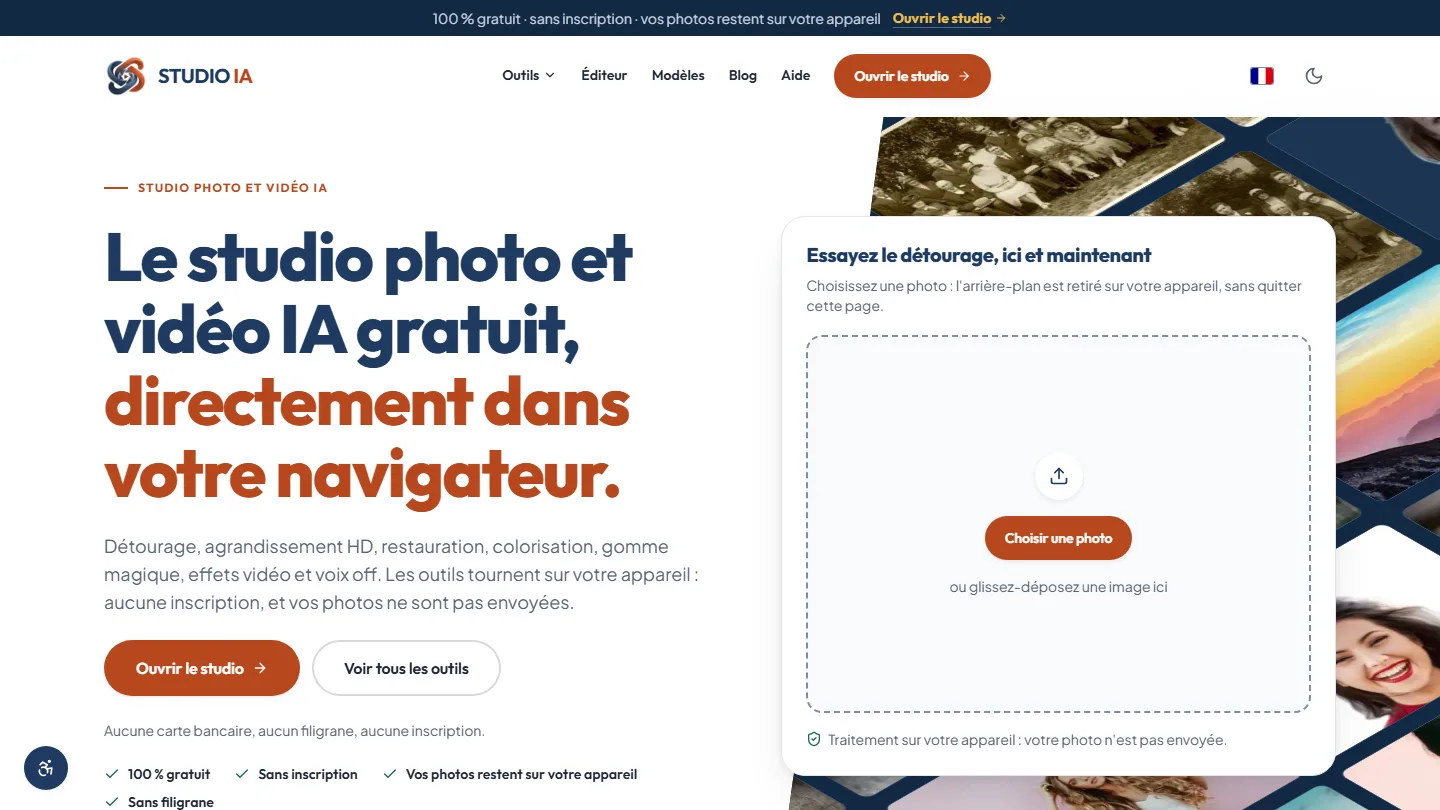 Web application & artificial intelligence
Studio AI
Eighteen AI-powered photo and video tools, each one saying for itself whether it runs in the browser or online: privacy becomes a check box, not a promise.
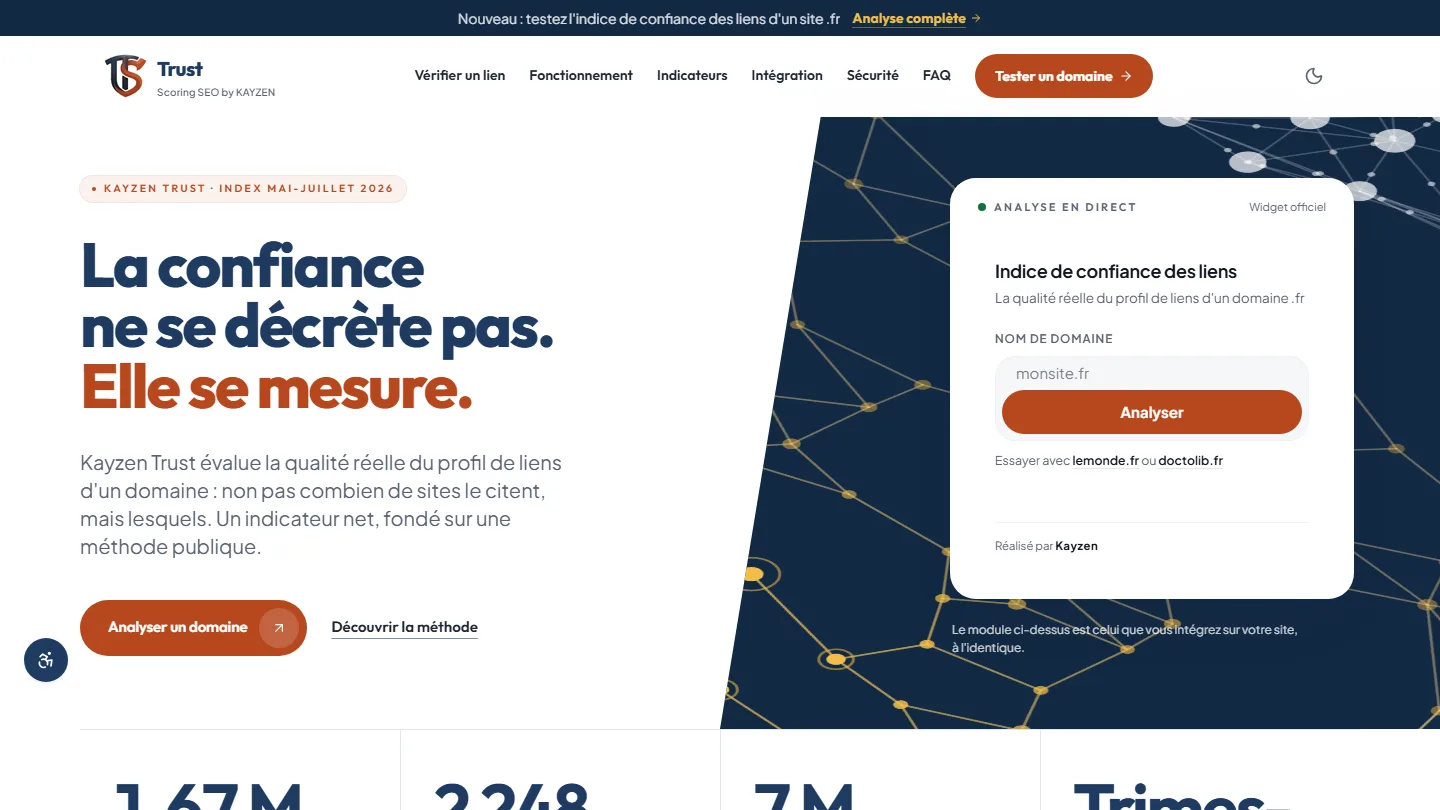 Web application & SEO
Kayzen Trust
A link indicator whose method is published: trust can be measured, and the gap with popularity gives away bought links.
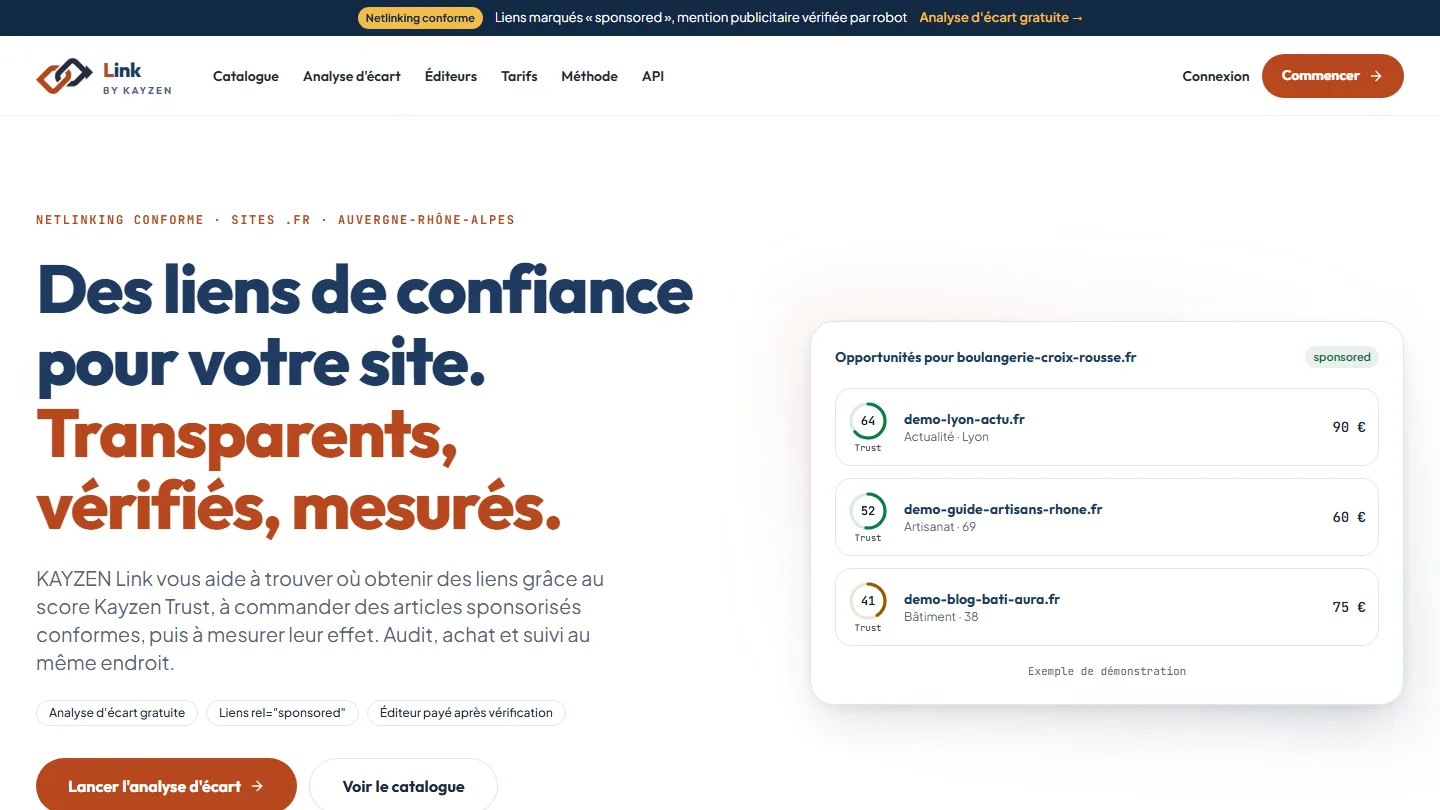 Web application & SEO marketplace
KAYZEN Link
Links bought in plain sight: marked sponsored, verified by a bot, paid only once checked.


The same high standards, for your website.
A free audit of your current site, a quote within 24 hours and written reasoning — like the case study you have just read. Pay in three interest-free instalments; local funding schemes checked before you sign.