Kayzen Trust
A link indicator whose method is published: trust can be measured, and the gap with popularity gives away bought links.
- Year
- 2026
- Stack
- Common Crawl · TrustRank · Web Components · API REST · Vite · Vercel
- Product design
- Scoring algorithm
- Data processing
- API
- Embeddable widget
- Presentation site

- .fr domains assessed in the May to July 2026 index
- 1.67 M
- reference sites at the start of the trust calculation
- 2,248
- links analysed between .fr domains
- 7 M
- compressed weight of the widget, with no dependencies or cookies
- 6.2 KB
What needed solving.
The background
Kayzen Trust is a link indicator published by KAYZEN from Lyon at trust.kayzen-lyon.com. It scores the trust a .fr domain receives through the links pointing to it. The current index is based on the Common Crawl graph from May to July 2026 and will be renewed every quarter. The site also offers a second tool, the Security score, which checks a suspicious address before you click on it.
The constraint
Google stopped displaying its PageRank in 2016. The scores that replaced it (Majestic's Trust Flow, Ahrefs' Domain Rating, Moz's Domain Authority) are useful, but their calculation is not published, they are available on subscription and displaying them depends on each publisher's terms. The manager of a small business can neither check how their site is scored nor show that score to visitors. The plain number of links, for its part, can be manufactured: a network of sites citing one another inflates popularity without proving anything.
The response
Do not count links; follow the trust they carry. Kayzen Trust takes up the principle of TrustRank, publicly described in 2004: a core of sites whose reliability is beyond dispute serves as the starting point, and trust flows along the links, weakening at each step. Raw popularity is calculated alongside, on the same scale from 0 to 100. It is the gap between the two that tells the story: high popularity and low trust point to an artificially built profile.
Every design choice, and the reason for it.
The widget is the demonstration
The module shown at the top of the home page is the one you embed on your own site, exactly as it is. The visitor enters a domain and reads the result without signing up; at the same time, they see the component they will be able to display on their own site. A faithful demonstration avoids the flattering screenshot that does not match the product delivered.
Two figures and a ratio, not a single score
A single score does not say where it comes from. The result displays trust (Kayzen Trust), popularity (Kayzen Authority) and their ratio, with three thresholds written out plainly: healthy profile from 0.7, to be watched between 0.3 and 0.7, low trust below 0.3. Added to these are the trust distance, i.e. the number of links separating the site from a reference source, and the number of .fr domains citing it.
An animation that shows the method
The “In motion” section makes trust flow across a fictitious network, in four stages: the core lights up, trust spreads, a cluster of sites citing one another gains popularity without gaining trust, then the verdict falls. The caption states that the network and the values are illustrative, so that the image is not mistaken for real data.
A fair comparison with the market
A table sets Kayzen Trust against the proprietary scores on five criteria: method, access, display, coverage and renewal. It acknowledges what the paid suites do better (worldwide coverage, more frequent updates) and names their publishers' brands, stating that KAYZEN is affiliated with none of them.
The limits written on the page
A “Stated limits” section sets out what the index is not: it is not a Google score, it only covers links between .fr domains, it relies on a sample of the web and it scores an entire domain, not each page. An indicator that writes down its limits is easier to judge than one that keeps them quiet.
What's under the bonnet.
- Common Crawl
- TrustRank
- Web Components
- API REST
- Vite
- Vercel
A public graph of 1.67 million domains
The data comes from the link graph published by Common Crawl, a foundation that crawls the web and makes its data available. From the May to July 2026 index, 1.67 million .fr domains and 7 million links between them were retained. Anyone can consult the source and redo the reasoning.
A core of 2,248 reference sites
Public administrations, universities, institutions and reference media form the starting point of the calculation. Trust starts from them, follows the outgoing links and decreases at each step. A network of sites cut off from this core receives none, however many links it exchanges.
Two measures calibrated on the same scale
Trust and popularity are projected onto a scale from 0 to 100. Without this calibration, the gap between them would mean nothing; with it, the ratio can be read at a glance, and it is the ratio that distinguishes a site cited by reliable sources from a site inflated by bought links.
A 6.2 KB web component with no dependencies
The widget is embedded in two lines: a script loaded as a module and a <kayzen-trust> tag. It weighs 6.2 KB compressed, depends on no library and makes no request until the visitor has started an analysis. It picks up the host page's typography and follows its theme, light, dark or automatic.
Keys tied to domains
A public key is only accepted on the declared sites: copied elsewhere, it is refused. Secret keys, reserved for proxy mode, are refused in a URL or from a browser and only work between servers. A daily quota, a cap per IP address and per key, and immediate revocation prevent a copied key from exhausting the service.
A link analysis that executes nothing
The Security score visits the page on the user's behalf, without executing its code, and records what often gives a scam away: imitation of a well-known site, redirects, certificate, domain age, a form that sends data elsewhere, presence in public threat lists. The result is a score out of 100 explained factor by factor, presented as an indicator and not as a guarantee.
How the site makes itself findable.
A tool that promotes itself
Every site that displays the widget shows an indicator signed KAYZEN to its own visitors. The free tool becomes a lasting point of contact with the agency, with no advertising and no forced link exchange.
An llms.txt file for assistants
The site publishes /llms.txt, which describes in a few lines the method, the link analysis, the widget integration, the API and the legal pages. An assistant asked about Kayzen Trust can thus present it without guessing.
A published method, and therefore a citable one
The method is described step by step on the home page: map, anchor, propagate, calibrate. An indicator whose construction is public can be explained, discussed and cited; that is what sets it apart from proprietary scores and what gives it a chance of being picked up.
Usable by everyone.
Since June 2025, the European Accessibility Act has required digital accessibility from a large share of online services. We build it in at the design stage rather than retrofitting it.
A published accessibility statement
The site publishes an Accessibility page giving its compliance status with the RGAA (the French accessibility standard), the accommodations offered, the means of redress and the contact for reporting a problem. An accessibility options button is present on every page.
No cookies, no trackers
Neither the site, nor the widget, nor the link analysis sets any cookie or tracker: no consent banner stands in front of the tool. The domain entered is sent to the API to obtain the score, without being stored; the address submitted for a link analysis stays in memory for 30 minutes at most, and the IP address is only used, in memory, to limit abuse.
What was delivered.
- Home — demonstration through the widget, index figures, method, indicators, comparison, integration, guarantees, limits, frequently asked questions
- Check a link — Security score of an address, explained factor by factor
- API — score of a domain and analysis of an address, with a key
- Accessibility, legal notice and privacy policy
How the project unfolded.
Map
Extraction of the .fr domains and the links connecting them from the Common Crawl graph of May to July 2026.
Anchor
Selection of a core of 2,248 reference sites: public administrations, universities, institutions, media.
Propagate and calibrate
Calculation of trust and popularity, then projection of both onto the same scale from 0 to 100.
Publish
Embeddable widget, API with a key, link analysis, presentation site and legal pages; launched in November 2026.
What we are often asked.
More of our work
 Web application & artificial intelligence
Studio AI
Eighteen AI-powered photo and video tools, each one saying for itself whether it runs in the browser or online: privacy becomes a check box, not a promise.
 Web application & API for developers
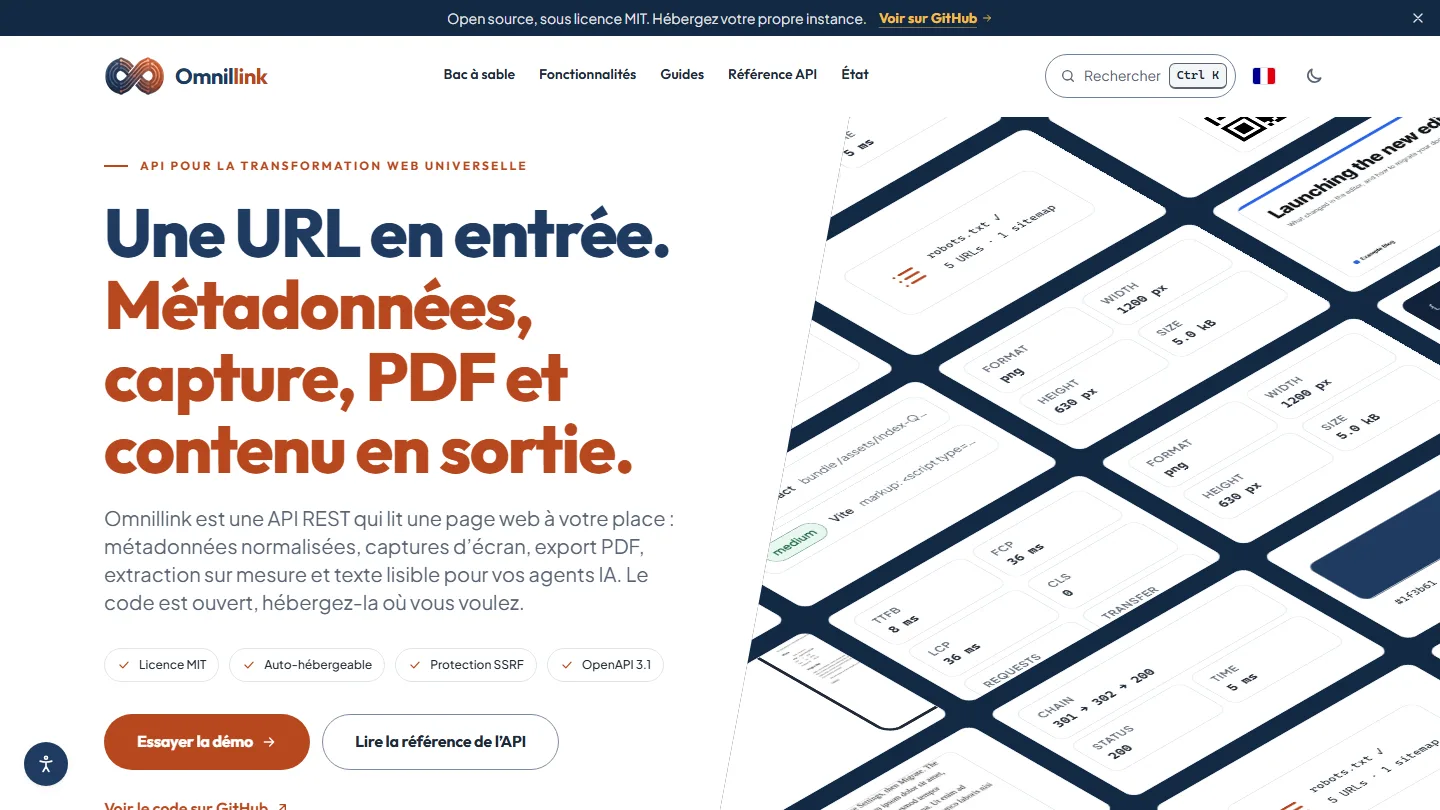
Omnillink
An address in, ready-to-use data out: an API that writes down its limits and attaches its measurements to every response.
 Open-source software & desktop application
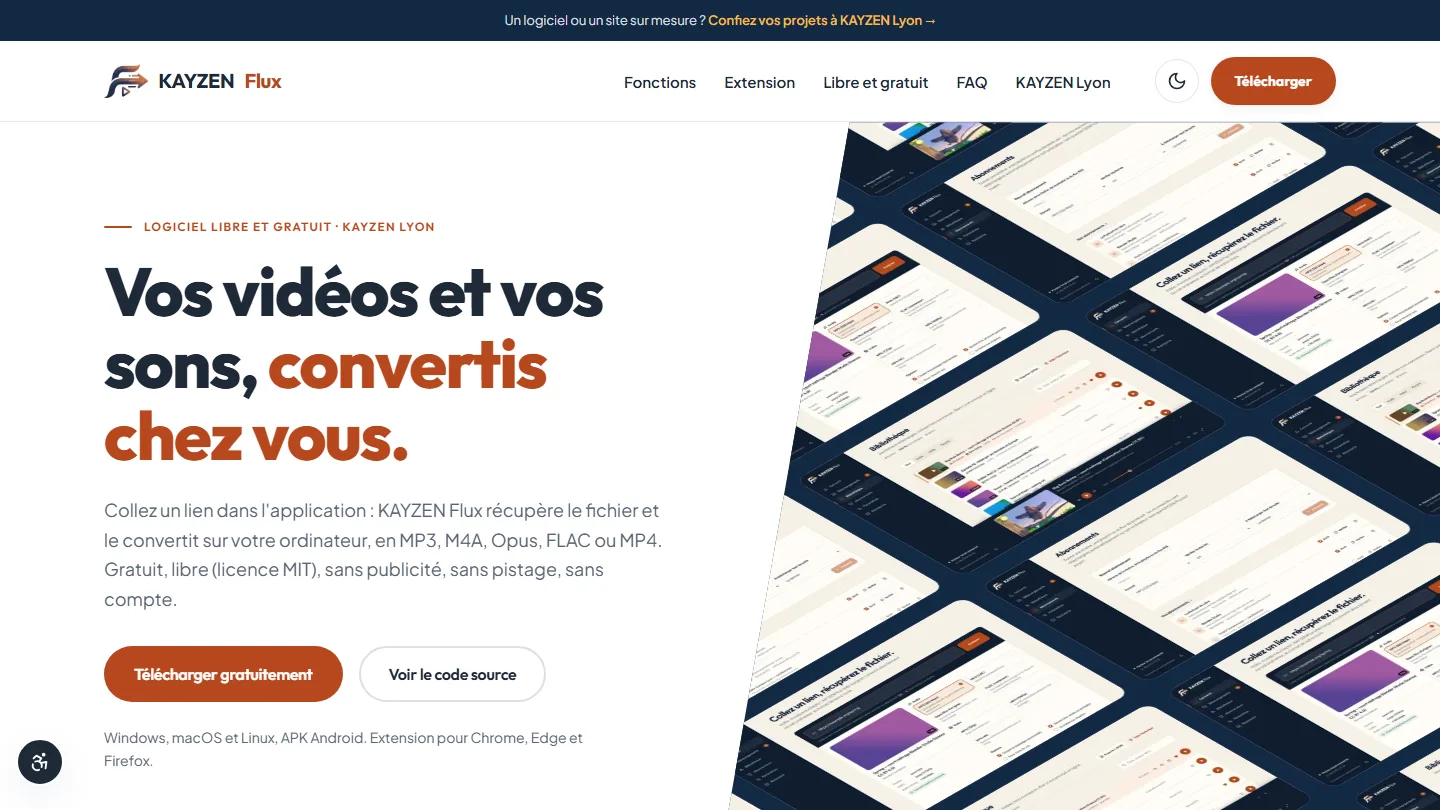
KAYZEN Flux
A converter with no server: the file never leaves the computer, and the code is public so you can verify it.


The same high standards, for your website.
A free audit of your current site, a quote within 24 hours and written reasoning — like the case study you have just read. Pay in three interest-free instalments; local funding schemes checked before you sign.